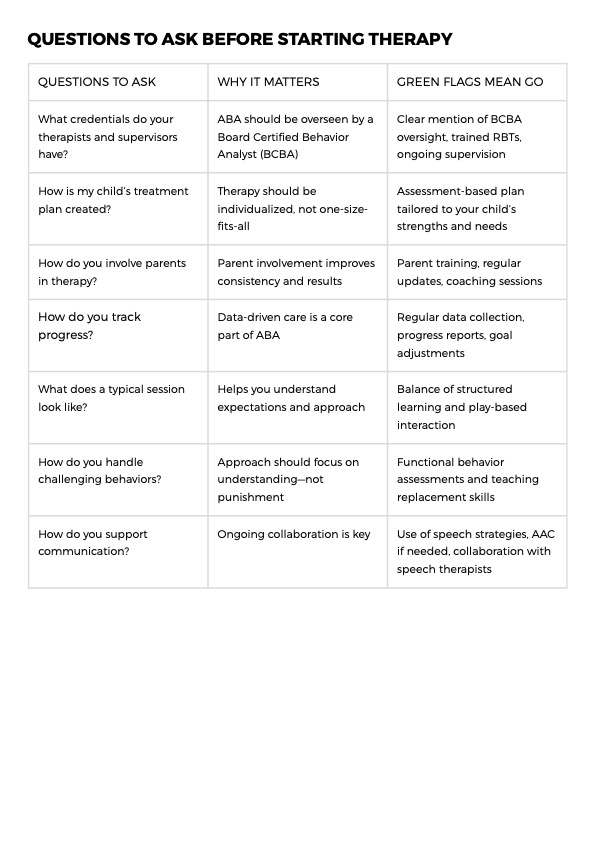
If your child has recently been diagnosed with autism or you’re noticing struggles with learning and behavioral challenges, you may have heard about ABA therapy.
And if you’re like most parents, you probably have questions about it all. Some of the more common questions are:
- Is this type of therapy the right fit for my child?
- How do I know if the ABA therapy center is a good on?
- What should I be looking for?
These are important questions.
Because while Applied Behavior Analysis (ABA) is widely recognized as the gold standard for helping children who are on the spectrum build communication, behavior, and daily living skills, not all ABA programs are the same.
Asking the right questions early on can help you find a provider who truly understands your child and supports your family. In the long run this eliminates misunderstandings and frustration.
Why Asking Questions Matters
Starting ABA therapy is a big step. It’s more than the services your child will receive; it’s a long-term relationship that’s built on trusting a team to support your child’s development during critical learning years.
Research continues to support that early, high-quality ABA intervention can significantly improve communication, adaptive behavior, and social skills, especially when started in early childhood (ages 2–6).
FACT: A landmark review published in Pediatrics highlights meaningful improvements in cognitive and language outcomes with early intensive behavioral intervention.
Here’s the part that most parents miss: positive outcomes depend heavily on how therapy is delivered. That’s why asking thoughtful questions upfront is one of the most powerful things you can do as a parent.
What High-Quality ABA Therapy Looks Like
Modern ABA therapy is very different from outdated stereotypes. In Arizona, the best programs focus on:
- Building communication and independence
- Teaching emotional regulation and coping skills
- Supporting social interaction and play
- Using positive reinforcement, not punishment
- Creating a safe, encouraging environment
FACT: Research published in the Journal of Autism and Developmental Disorders supports the use of naturalistic and play-based ABA approaches to improve social communication and engagement.
In other words, therapy should feel like learning through connections, not compliance.
When Is It Time To Start ABA Therapy?
This is one of the most emotional questions parents face and the truth is, most families don’t start from a place of certainty. They start from a place of concern.
Key signals to watch for are that your child isn’t talking as you expected, their meltdowns are becoming more frequent or intense, and any kind of transition from one moment to a different one feels like too much. Some children struggle with social interactions, while others have difficulties with daily routines like dressing, eating, or leaving the house.
Often parents receive misguided advice to sounds something like, “Let’s wait and see,” adding more uncertainty to an incredibly hard situation.
Here’s what we wish parents knew… If something feels off, don’t have to wait to get answers and help.
TIP: The American Academy of Pediatrics recommends early evaluation and intervention as soon as concerns arise, even before a formal diagnosis is confirmed.
Early support doesn’t just help your child it can also reduce frustration (for both of you), build better communication faster, and prevent behaviors from becoming habitual.
A Parent-Centered Way to Think About ABA Therapy
If your daily life feels harder than it should and if your child is struggling to communicate or cope, or if you’re constantly guessing at what they need, it’s probably time to explore ABA therapy.
Not because something is wrong, but because your child deserves the right support that works with their brain, not against it.
ABA therapy focuses on breaking down skills into manageable steps and teaching them in a way that makes sense for your child.
These steps can look like:
- Requesting wants and needs
- Following simple instructions
- Playing with peers
- Managing frustration
- Completing daily routines
Over time, these small skills build into meaningful independence and more confidence, especially for divergent thinkers.
Parents: You Don’t Have to Figure This Out Alone
Choosing ABA therapy can feel overwhelming. There are decisions, timelines, insurance questions, and emotions all mixed together, but you don’t have to have all the answers right now.
Start with questions, stay curious, and trust your instincts.
Remember: the goal isn’t to “fix” your child. It’s to support them in becoming more confident, capable, and connected in their world.
If you live in San Tan Valley, East Valley, or Queen Creek, Arizona and you’re exploring ABA therapy for your child, having a supportive and experienced team makes all the difference.
We’re your local connection to ABA therapy. Contact us today. We love working closely with families to:
- Create individualized therapy plans
- Support communication and behavior in real-life settings
- Provide parent guidance and ongoing collaboration
- Help children build confidence and independence step by step
Contact ABA Connections in San Tan Valley today to schedule a consultation and learn how we can support your child and your family.