

Your child covers their ears in a restaurant, crashes into the couch repeatedly, refuses certain clothing, or seems to completely ignore you when you call their name, and you don’t know what to do to help.
Sound familiar?
For many children with autism and other neurodivergent learning differences, the world can feel very different from the way it feels to others. Everyday sights, sounds, textures, movements, and even smells can affect how they learn, behave, and interact with the people around them.
Understanding sensory differences can help parents move from frustration to understanding and create spaces where their child can feel more comfortable, confident, and successful.
What Are Sensory Differences?
Our brains are constantly pinging with information that we receive from our senses. Most of us consider that the five basic senses: sight, sound, touch, taste, and smell are all we need to understand the world around us.
But for most children they learn and grow through information from additional systems that help them understand movement and balance (vestibular system), body awareness and position (proprioception), and internal body signals like hunger, thirst, and temperature (interoception).
For some neurodivergent children, the brain processes this information differently. Research suggests that sensory processing differences are very common among autistic children and can significantly affect daily functioning, learning, and social participation.
Here’s the key point of this article: these processing differences are not behavioral choices. They are neurological responses to how the brain interprets sensory input.
Sensory Seeking vs. Sensory Avoiding
Children often fall into one of two broad categories, although many experience both sensory situations depending on what the child is facing.
Sensory Seeking
Sensory seekers actively look for additional sensory input because it helps their nervous system feel organized and regulated.
You might notice a child who:
- Jumps, spins, or climbs constantly
- Loves bear hugs and deep pressure
- Crashes into furniture or pillows
- Touches everything around them
- Makes repetitive noises or sounds
Parents sometimes hear comments like, “They have so much energy” or “They never sit still.” The reality is that your child may be using movement and sensory input to help their brain focus and stay regulated.
Sensory Avoiding
Sensory avoiders experience certain sensory input as overwhelming or uncomfortable. You may notice a child who:
- Covers their ears in noisy environments
- Refuses certain clothing textures
- Becomes upset during haircuts or tooth brushing
- Avoids crowded places
- Struggles with bright lights or strong smells
What looks like stubbornness is actually a child trying to protect themselves from sensory overload.
Why Does My Child Seem to Ignore Instructions?
One of the most common concerns parents share is that they are certain that their child hears them but that they don’t listen. Sometimes this is true. Other times, sensory processing plays a significant role.
Try this exercise. Imagine trying to follow directions while a loud air conditioner is running and the fluorescent lights keep flickering. There may be groups of people talking nearby, plus your clothes feels itchy, and your heart is racing because you are anxious about what comes next.
Are you getting it now?
For some children, the brain is working so hard to manage sensory information that there is very little capacity left for listening and processing verbal instructions. What appears to be noncompliance could be sensory overload.
Why Public Meltdowns Happen
Many parents notice their child does well at home but struggles in public places. Stores, restaurants, birthday parties, and school events often contain multiple sensory challenges at once. Think bright lights, unexpected noises, crowds, strong smells, or a complete change in a comfortable routine.
When the nervous system becomes overwhelmed, many children respond with a meltdown.
A meltdown is not a tantrum or a manipulation strategy. It is a STRESS RESPONSE that occurs when the brain can no longer manage the sensory and emotional demands being placed upon it.
Understanding the trigger helps parents respond with support instead of punishment.
Creating Sensory-Friendly Routines at Home
Making small adjustments can make a big difference. One of the most effective strategies is creating predictable routines. Children who experience sensory challenges often feel safer when they know what to expect.
Many parents find that using these four key strategies really help their child manage those big feelings associated with sensory overload.
- Use visual schedules
- Provide transition warnings
- Keep consistent bedtime routines
- Create quiet spaces for breaks
Pay attention to patterns.
You may notice that your child struggles most during certain times of day or at specific activities. These observations can help you proactively support their sensory needs before that meltdown happens.
How ABA and Occupational Therapy Work Together
Many families are surprised to learn that ABA therapy and occupational therapy (OT) often complement one another. Occupational therapists focus on understanding sensory processing and helping children develop strategies to navigate sensory challenges.
ABA therapists focus on helping children build skills and use those strategies consistently across daily routines.
For example: A child who becomes overwhelmed by noise in the classroom may work with an OT to identify helpful sensory supports, such as noise-reducing headphones.
An ABA therapist can then help the child learn when to request the headphones, how to use them independently, and how to communicate when they need a break.
Together, the therapies support both sensory regulation and functional independence.
Teaching Coping Tools and Sensory Breaks
You can teach your children coping strategies at home, so they know what to do next time they feel overwhelmed.
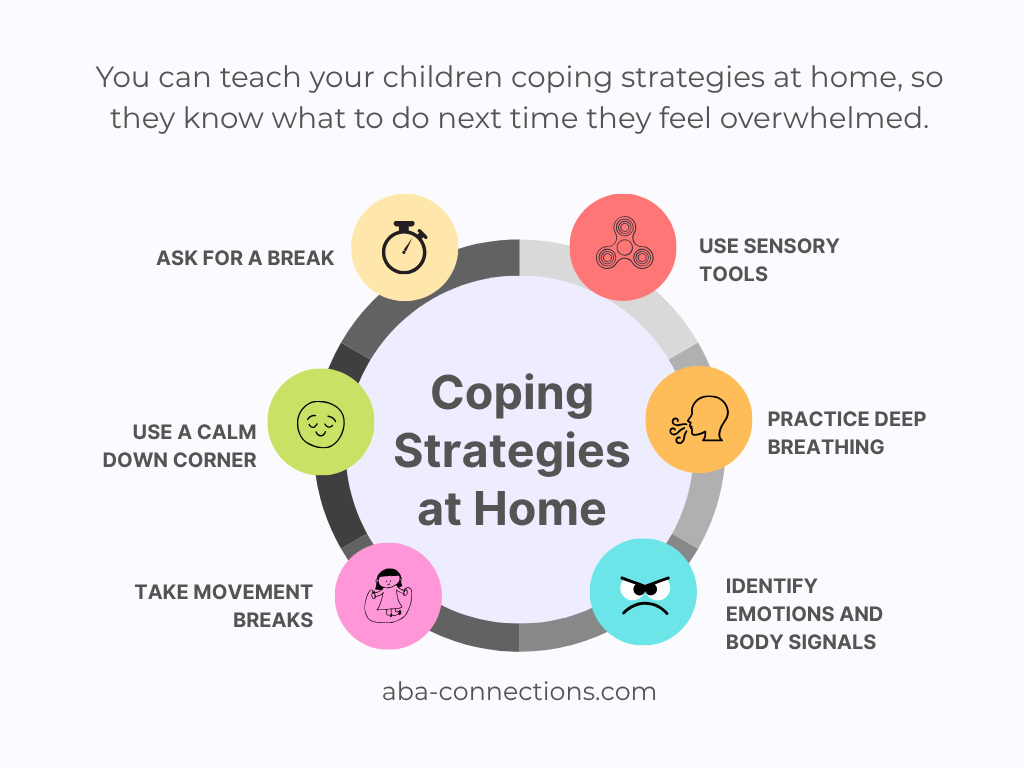
Research shows that sensory-based interventions can improve participation and support emotional regulation when individualized to a child’s needs.
It’s not possible or practical to try to eliminate sensory differences, but you can help your child recognize what their body needs and develop tools that allows them to participate more comfortably in everyday activities.
Looking Beyond the Behavior
One of the most important shifts that you can make as a parent is to ask: “What is my child experiencing?”Instead of, “Why are they behaving this way?”
When we understand sensory differences, many behaviors begin to make sense.
The child who covers their ears is not being difficult.
The child who constantly moves may not be hyperactive.
The child who melts down at the grocery store may be overwhelmed rather than defiant.
At ABA Connections, we believe that behavior is communication. By understanding the sensory world our children experience every day, we can build a support system that help them feel safe, confident, and successful both at home and in the community.
When children receive the right combination of understanding, sensory supports, and skill-building strategies, they gain much more than coping skills, they gain the confidence to navigate a world that often feels much bigger and louder than it does for everyone else.